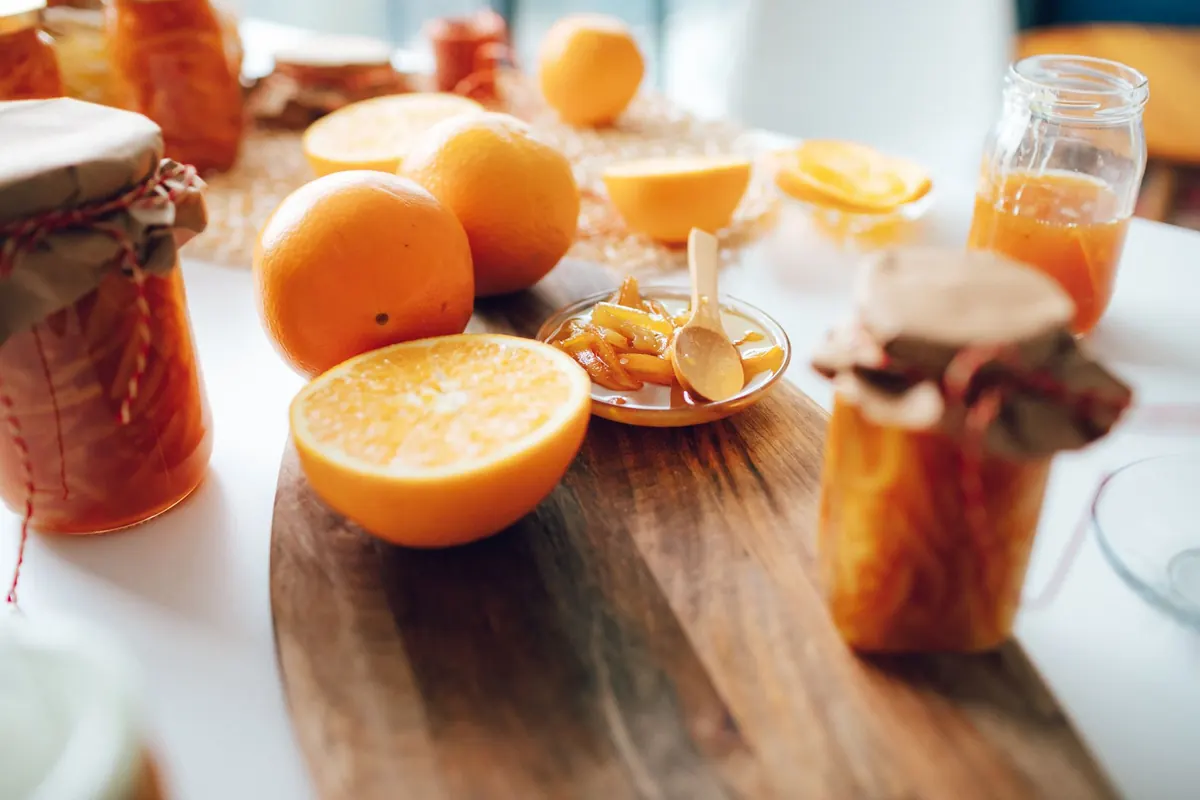
Marmalade is forgiving right up until the moment it isn't. You can simmer peel for hours, adjust the sugar at the last minute and still end up with something worth spreading on toast. Then one morning you open a jar and find syrup, or a dark rubbery brick, and realise the batch was decided long before you potted it.
Almost every fault traces back to a handful of things: pectin, acid, timing, the set test and the jar. Here is the list to run through when a batch misbehaves, and the habits that keep it from happening again.
1. Not Enough Pectin, Not Enough Acid
Marmalade sets when pectin, acid and sugar form a network that traps liquid. Citrus fruit is rich in pectin, but not evenly: most of it sits in the pith, the inner membranes, the pips and the skin of slightly underripe fruit. Trim away every trace of white pith and throw out the pips with the soaking water, and you have removed your setting power before the pan goes on the heat.
Tie the pips and membranes into a square of muslin and simmer them alongside the fruit. Squeeze the bag against the side of the pan before you add sugar — carefully, it is hot — then discard it. Add the juice of one or two lemons for acid and brightness. Ripe mid-season oranges need more help than Sevilles in January, and a little commercial pectin is a legitimate tool if you follow its instructions exactly; some types go in at the start, others at the end.
Signs you under-pectined: a syrup that never thickens, peel floating in thin liquid, or a spoonful that slides off a cold plate without wrinkling.
2. Boiling Long Past the Set
More boiling does not make a better set. Past the setting point the sugar concentration climbs, the colour slides from amber to brown, the fresh citrus oils cook off and the texture turns to glue. Overboiled marmalade tastes caramelised and tired rather than bright.
The setting point for most marmalade sits around 104–105°C. Take the pan off the heat to test, because the mixture keeps cooking while you fuss with a saucer. A batch that needs two more minutes is normal; one that has had twenty more is a different, darker preserve. If you overshoot, a little hot water stirred in and re-tested can loosen a set that has gone too firm — but you cannot bring back the flavour.
3. Ragged Shreds and a Rushed Soak
Shred size decides how long the peel needs and how the finished texture feels. Thin-cut peel can be tender in forty minutes; thick chunks may need twice that. Mix the two in one pan and some pieces collapse while others stay chewy.
Cut consistently, with a sharp knife, and accept that hand-cut shreds will never look machine-made. Soaking the peel overnight in cold water does two jobs: it softens the peel and pulls out some of the harshest bitterness. Skipping the soak is not fatal — just simmer longer and taste as you go.
Bitter is not a fault
Marmalade should have backbone. Harsh, throat-catching bitterness is different, and usually means too much pith left on the shreds or water boiled down and reused. Trim the pith, but do not scrape the peel to translucence; a little white is part of the character.
4. Sugar Added at the Wrong Moment
Two versions of this mistake. The first is adding sugar before the peel is tender — sugar firms the peel, and it can stay stubbornly tough however long you boil. Cook the peel in water first, until a shred squashes easily between your fingers.
The second is tipping in cold sugar all at once, which drops the temperature and stretches out the boil. Warm the sugar in a low oven on a tray, add it in a steady stream and stir until it has completely dissolved. Check by feeling a cooled drop on the back of a spoon: gritty means keep stirring. After that, stop stirring, keep the boil steady, and brush any crystals down from the sides of the pan with a wet pastry brush — stray crystals seed a grainy marmalade.
Resist the urge to cut the sugar to make it less sweet. Sugar is the preservative. If the finished marmalade is cloying, a squeeze of lemon or grapefruit juice balances it far better than a smaller batch of sugar ever will.
5. Misjudging the Set
Set is judged by behaviour, not by hope. Take the pan off the heat and use more than one test.
- Cold saucer: chill a saucer, drop on a teaspoon of marmalade, let it cool for a minute, then push it with a fingertip. If the surface wrinkles and the drop holds its shape, it is ready.
- Thermometer: 104–105°C is the classic target. Stir before reading, and keep the probe off the base of the pan.
- Flake test: lift a spoonful, let it cool slightly, then pour it back. Set marmalade falls in a sheet or flake; under-set marmalade runs in a thin thread.
- The cooling check: marmalade thickens as it cools, so if a test is borderline, pot one small jar and check it the next day before boiling the rest further.
If the batch is still liquid the following morning, reboil it with a little extra lemon juice and pectin — or accept it as a very good citrus syrup for yoghurt and cocktails.
6. Jars That Do Not Seal
Most sealing problems come down to temperature and cleanliness. Marmalade should go into hot, sterilised jars while it is still hot, and the jars should be filled and closed without dawdling.
- Wash jars and lids in hot soapy water, rinse, then sterilise — a hot oven, a pan of boiling water or a hot dishwasher cycle all work. Keep them hot until filled.
- Fill to about 5mm below the rim. More headspace means more air and a slower seal; less means marmalade on the threads.
- Wipe the rim with a clean, damp cloth before the lid goes on. One sticky smear can break a seal.
- Use sound lids. Two-piece lids can be reused if the sealing compound is intact; dented or worn lids cannot.
- Follow your recipe's processing method. High-sugar preserves are often hot-filled and left to seal, but many recipes call for a water bath, and that instruction is not optional.
Let jars cool undisturbed for twelve to twenty-four hours, then press the centre of each lid. A concave lid that stays put is sealed; one that clicks up and down is not, so refrigerate that jar and eat it first. If you ever find mould on the surface, throw out the whole jar rather than scraping it off.
A Five-Minute Check Before the Next Batch
Read the recipe through once, then check three things: does it include the pips and membranes, does it say when to add the sugar, and does it explain how the jars should be processed? Put a saucer in the freezer and a thermometer on the counter. Have the jars washed and ready before the marmalade reaches setting point, because that is the one moment when everything happens quickly.
Marmalade rewards attention more than technique. Taste at every stage, test the set more often than you think you need to, and write a note on the label — fruit, date, how the set turned out. Two or three batches in, you will know your own stove, your own fruit and your own preferred bitterness, and the mistakes on this list will stop finding you.
Photo: mattyphotographyy / Pixabay